

Which wetland design stores the most carbon? Pilot study has an answer
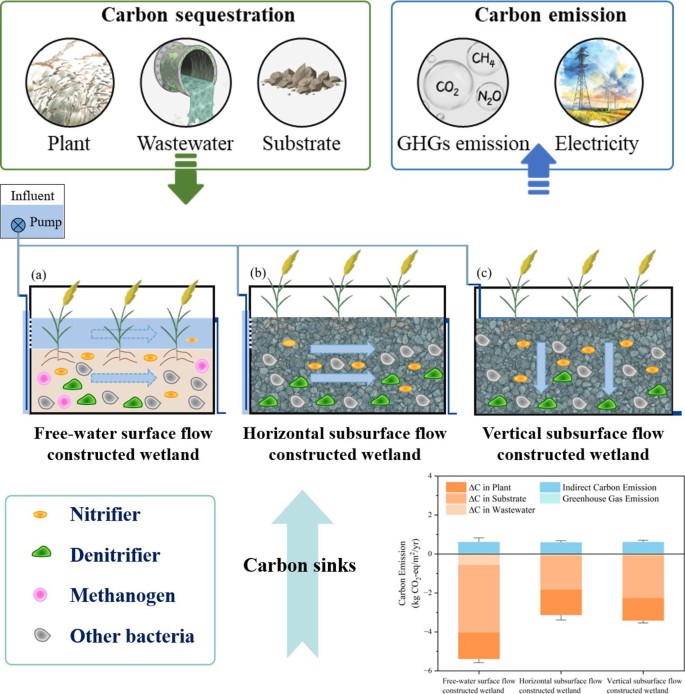
Carbon budgets of different constructed wetland configurations.
GA, UNITED STATES, April 1, 2026 /EINPresswire.com/ -- Constructed wetlands are often promoted as low-energy systems for wastewater treatment, but their full climate value has remained unclear. This study shows that three common pilot-scale wetland designs all acted as net carbon sinks over a year, even though their greenhouse gas patterns differed markedly. Free-water surface flow systems stored the most net carbon, while horizontal and vertical subsurface flow systems removed pollutants more efficiently. Most retained carbon was stored in the substrate rather than in plants or water. The findings suggest that wetland design can be tailored to balance water purification and climate goals, offering a more practical path toward wastewater treatment systems that are both effective and lower in carbon impact.
Wastewater treatment is increasingly under pressure to deliver cleaner effluent with lower energy use and fewer greenhouse gas emissions. Constructed wetlands have drawn attention because they rely on ecological processes such as filtration, microbial transformation, and plant uptake rather than energy-intensive machinery. Yet the climate role of these systems has remained debated. Different wetland configurations can alter oxygen conditions, microbial communities, plant growth, and therefore emissions of carbon dioxide, methane, and nitrous oxide. Earlier studies often focused on only one or two gases or ignored indirect emissions such as electricity consumption, making it difficult to judge whether wetlands are overall carbon sources or carbon sinks. Based on these challenges, in-depth research was needed on how wetland configuration shapes full-year carbon performance.
Researchers from Chongqing University, China, reported on January 20, 2026 in ENGINEERING Environment that three pilot-scale constructed wetland configurations—free-water surface flow, horizontal subsurface flow, and vertical subsurface flow—showed distinct trade-offs in pollutant removal and greenhouse gas emissions, but all ultimately functioned as annual net carbon sinks.
To compare configurations under controlled conditions, the team built three outdoor pilot-scale wetlands with identical dimensions and planted them with Phragmites australis. The systems were operated continuously for twelve months using synthetic tailwater, and the researchers monitored nutrient and COD removal, monthly greenhouse gas fluxes, plant growth, substrate carbon, water carbon, and microbial community features. The design allowed them to combine treatment performance with a full carbon budget rather than relying on single gas measurements alone.
The results revealed clear functional differences. Horizontal subsurface flow and vertical subsurface flow performed better than free-water surface flow in removing NH4+-N, NO3−-N, and COD. By contrast, free-water surface flow showed the strongest CO2 uptake but also the highest CH4 emissions, linked to greater plant biomass and a higher abundance of methanogenic microorganisms such as Methanobacterium. Vertical subsurface flow produced the highest N2O emissions, likely because its more oxidizing conditions favored incomplete nitrogen transformation. Across all systems, the substrate accounted for the largest share of stored carbon, at 55.53%–64.50%, far exceeding plants and wastewater. When direct greenhouse gas emissions and indirect electricity-related emissions were balanced against carbon accumulation, all three wetlands emerged as carbon sinks. Free-water surface flow delivered the highest annual net sink capacity at 4.78 kg CO2-eq/(m2·yr), followed by vertical subsurface flow at 2.81 and horizontal subsurface flow at 2.54.
The study indicates that no single wetland configuration is universally optimal. Instead, performance depends on whether the priority is stronger pollutant removal or greater carbon sequestration. The authors conclude that subsurface-flow systems are more suitable when treatment efficiency is the main target, while free-water surface systems may be preferred when low-carbon operation is the central objective. Their year-round carbon budget also highlights that substrate carbon storage—not just visible plant growth—plays the dominant role in determining whether these systems deliver a climate benefit.
The findings offer a more precise framework for designing next-generation nature-based wastewater treatment systems. For cities and rural communities seeking lower-energy sanitation options, constructed wetlands could be selected not only for water treatment performance but also for carbon outcomes. The work also suggests practical directions for improvement, including reducing electricity-related emissions, optimizing substrates, and choosing plant species that maintain strong carbon uptake in colder seasons. More broadly, the study strengthens the case for constructed wetlands as multifunctional infrastructure that can support pollution control, ecological restoration, and climate mitigation at the same time.
References
DOI
10.1007/s11783-026-2158-0
Original Source URL
https://doi.org/10.1007/s11783-026-2158-0
Funding information
Special appreciation is extended to the Chongqing Science Fund for Distinguished Young Scholars, China (No. CSTB2022NSCQ-JQX0023) and Fundamental Research Funds for Central Universities, China (No. 2024IAIS-ZD010) for providing financial support for this study.
Lucy Wang
BioDesign Research
email us here
Legal Disclaimer:
EIN Presswire provides this news content "as is" without warranty of any kind. We do not accept any responsibility or liability for the accuracy, content, images, videos, licenses, completeness, legality, or reliability of the information contained in this article. If you have any complaints or copyright issues related to this article, kindly contact the author above.
